Great room for growth in the shipbuilding industry
(TTDN) - Currently, Vietnam's shipbuilding industry ranks 7th in the world, accounting for 0.61% of the global shipbuilding market share, so there is still a lot of room for development.
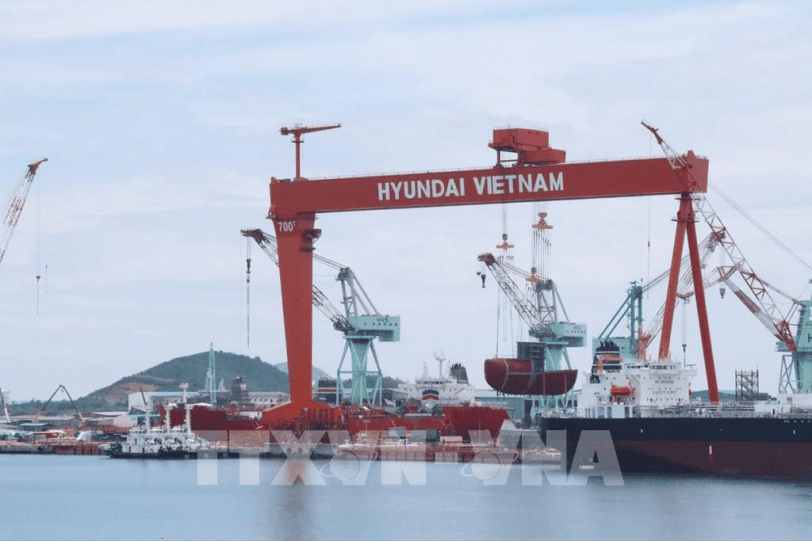
The 700-ton Goliath crane was put into operation at HVS Shipyard. (Photo: VNA)
In the context of the ever-increasing demand for new shipbuilding in the country and around the world, this is a good space to develop and upgrade the shipbuilding industry of Vietnam. Currently, the shipbuilding industry of Vietnam is ranked 7th in the world, accounting for 0.61% of rankedAccording to the Vietnam Maritime and Inland Waterways Administration (Ministry of Construction), by 2030, the size of Vietnam's seagoing fleet is expected to increase to 1,750 ships, with a total tonnage of up to 18 million tons. The demand for new shipbuilding in the country by 2030 is about 16 - 41 ships/year, equivalent to a tonnage of 0.7 - 0.8 million tons/year, including the number of newly built ships and replacements of old fleets. At the same time, the demand for new shipbuilding in the world by 2030 is expected to grow by 3.95%/year, increasing to 5,284 ships/year, with a tonnage of 311.2 million tons/year.
With the capacity to build new ships in Vietnam at about 3.5 million tons/year, Deputy Director of the Vietnam Maritime and Inland Waterways Administration Hoang Hong Giang assessed that the capacity of Vietnam's shipbuilding industry can participate in the world market. Accordingly, Vietnam's capacity to build new foreign ships will reach 2.7 - 2.8 million tons/year, accounting for 0.88 - 0.9% of the global shipbuilding market share by 2030.
Statistics from the Vietnam Maritime and Inland Waterways Administration also show that there are currently 88 shipbuilding enterprises and 411 inland waterway vehicle building establishments nationwide. Of these, there are about 120 enterprises building and repairing ships with a tonnage of over 1,000 tons. The capacity to build new seagoing vessels is about 3.5 million tons/year with transport vessels over 5,000 DWT.
For specialized ships, factories build new tugboats, towboats, fishing control ships, search and rescue ships, construction ships, aluminum-hulled high-speed boats, search and rescue ships, service ships... enough to serve domestically and for export; in addition, they can undertake to build and repair some military ships.
However, in the face of the trend of green energy conversion and carbon emission reduction, the domestic shipbuilding industry is also facing many challenges as shipbuilding facilities do not have enough infrastructure and resources to produce green ships; at the same time, there are no clear preferential policies on taxes, fees, and finance to support green energy conversion.
On the side of the Shipbuilding Industry Corporation (SBIC), Chairman of the Board of Members Pham Hoai Chung also assessed that the trend of converting to green energy and alternative fuels is affecting the shipbuilding industry.
Along with that, the Vietnamese shipbuilding industry in recent times has mainly developed in breadth with the main proportion of processing and assembly, so it has not increased high value. Most of the infrastructure and technology of Vietnamese shipyards have been invested for a long time, are not synchronized in capacity as well as technology, and lack of capital for technological innovation, so the ability to compete with modern products in the international market is still low. Limitations in design work also lead to the ability to develop sample products to adapt to the market is still low.
Despite the challenges, SBIC Chairman Pham Hoai Chung said that Vietnam's shipbuilding industry has many advantages when the demand for maritime transport is constantly increasing, and the export of goods by sea accounts for a large proportion of the country's total export turnover. At the same time, the shipbuilding industry has built most of the general cargo ships, bulk carriers, oil tankers, car carriers, and built a number of supporting industrial facilities to support the shipbuilding industry.
Currently, foreign investment in the shipbuilding industry is increasing, especially from countries with advanced technology. This creates opportunities to learn from experience, transfer technology, and improve the exploitation capacity of domestic shipbuilding enterprises through cooperation and technology transfer opportunities.
“The shift of the shipbuilding industry from Europe to Asia is a great opportunity for the Vietnamese shipbuilding industry. To seize this opportunity, we need to take advantage of and develop the existing advantages of strategic location, competitive labor costs, and the current process of technology transfer and foreign investment,” said SBIC Chairman Pham Hoai Chung.
Mr. Hoang Long, Head of Transport Department, Vietnam National Shipping Lines (VIMC) said that with the plan to rejuvenate the fleet including newly built ships, VIMC has the need to build and repair ships, use services provided for operation, exploitation, preservation and maintenance of equipment and ships. Currently, VIMC has cooperated with SBIC in specialized shipbuilding projects such as container ships, bulk carriers, etc., thereby improving the competitiveness as well as investment efficiency of the enterprise.
The leader of the Vietnam Maritime and Inland Waterways Administration said that the shipbuilding industry is an investment incentive industry, with many support policies on tax, land, etc. stipulated in the law. However, in the near future, there will be an overall assessment of the effectiveness, efficiency and suitability of incentive policies with current laws to propose amendments in line with the socio-economic development situation and the strategy for developing the marine economy in the new period.
Emphasizing the importance of the shipbuilding industry, Deputy Minister of Construction Nguyen Xuan Sang said that in the context of the National Assembly determining the growth target of 8% in 2025, growth of all economic sectors, including the development of the marine and maritime economy, is needed. Developing a sustainable shipbuilding industry will help Vietnam fulfill its commitments to reduce net emissions, towards the Net Zero target by 2050.
Resolution No. 36-NQ/TW dated October 22, 2018 of the 8th Central Conference, Session XII, on the Strategy for Sustainable Development of Vietnam's Marine Economy to 2030 affirms the position and importance in developing the marine economy, and at the same time determines the task of making our country a strong maritime nation, rich from the sea.
Accordingly, the goal is for purely marine economic sectors to contribute about 10% of the country's GDP; the economy of 28 coastal provinces and cities is estimated to reach 65-70% of the country's GDP. Marine economic sectors develop sustainably according to international standards; control the exploitation of marine resources within the resilience of the marine ecosystem./.